
Diabetic-Friendly Sourdough: 10 Ten Questions Answered


Sinless Sourdough™
The Complete Diabetic-Friendly Sourdough FAQ
10 Essential Questions Answered
If you are managing type 2 diabetes, pre-diabetes, or simply keeping a close eye on your metabolic health with a Continuous Glucose Monitor (CGM), bread can seem like one of those foods you have to give up.
But healthy blood-glucose management isn’t just about diabetes. It can also be an important part of supporting a healthy weight and maintaining weight loss. Blood glucose, insulin and other metabolic hormones — including cortisol — are interconnected, and large fluctuations in blood glucose can be part of a broader metabolic picture.
The goal isn’t to fear every rise in blood sugar. It’s to find an eating pattern that helps support stable blood glucose, metabolic health and sustainable weight management.
Traditional bread is typically high in digestible carbohydrate, and even products marketed as “keto” or “low carb” can produce very different glucose responses from person to person.
The answer isn’t as simple as saying that all traditional sourdough is good, or that all keto sourdough is good. The ingredients, the fermentation process, the amount you eat, and most importantly, your individual response all matter.
One Important Thing Before We Begin
Everyone’s blood sugar behaves uniquely. Two people can eat exactly the same bread in exactly the same portion and see completely different glucose responses.
Where I share my own CGM results below, that’s my personal experience, not a promise of your result. Keep that in mind throughout — I won’t repeat it after every answer, but it applies to all of them.
Why Sinless Sourdough Created This Approach
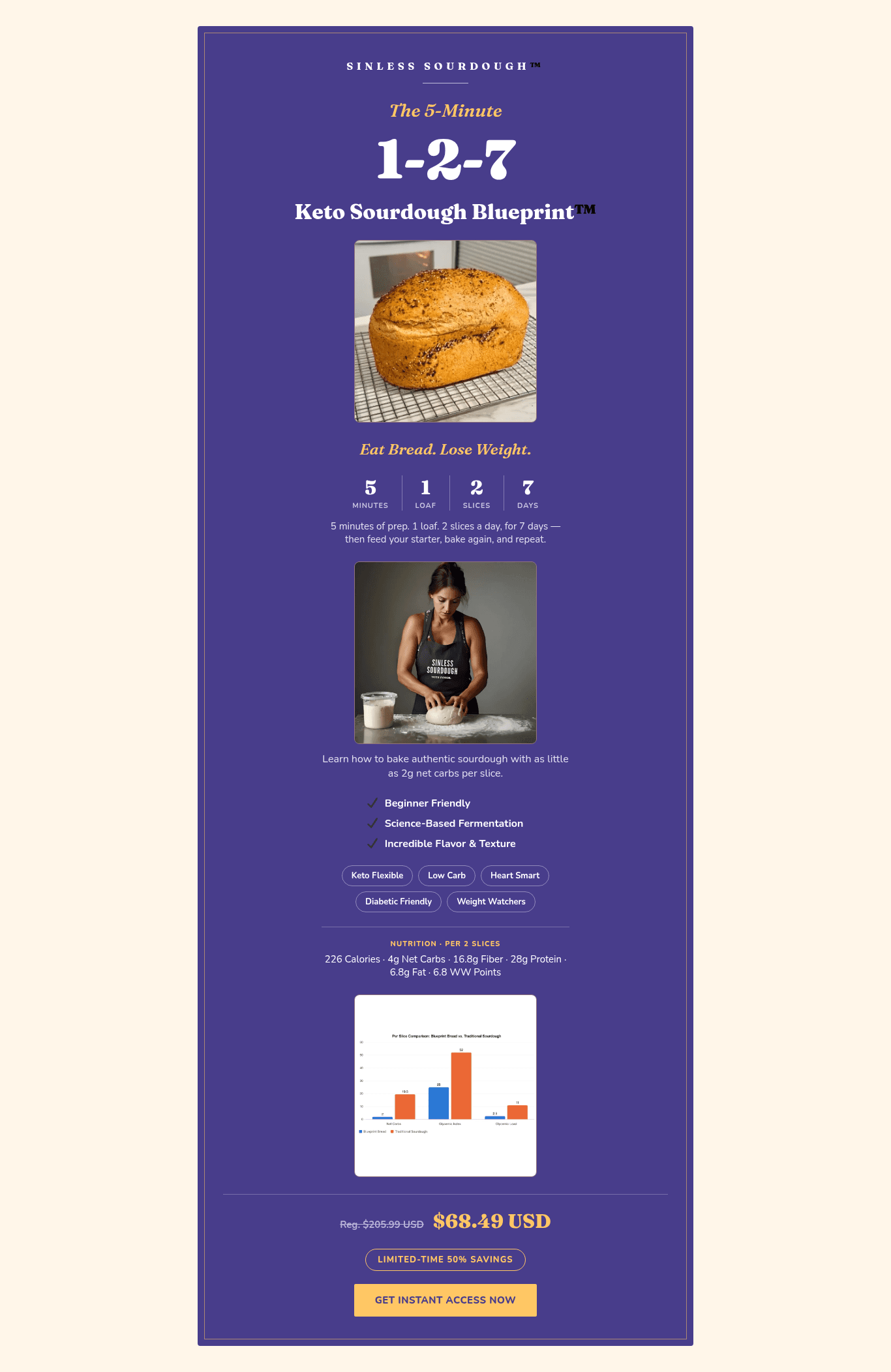
Sinless Sourdough™ focuses on keto sourdough for people who want to keep eating real bread while paying closer attention to carbohydrates, protein, fibre, and glucose response. Our 5-Minute 1-2-7 Keto Sourdough Blueprint™ was developed around that approach — combining genuine fermentation with a lower-net-carb, higher-protein formula specifically so the CGM results discussed throughout this page have something concrete behind them, not just a marketing claim.
Written by Shari MAC, CEO and founder of Sinless Sourdough. 30+ years in the food and wine industry, international award-winning cookbook author, former syndicated food and wine journalist. Shari developed the Flexible Keto approach to sourdough after losing over 70 lbs and shifting her own work from gourmet food and wine to low-carb baking.
https://sinlesssourdough.com/shop/
1. Can People With Diabetes Eat Sourdough Bread?
Yes, many people with diabetes can include sourdough bread in their diet — but traditional sourdough still comes with real limits worth understanding. Having diabetes doesn’t automatically mean eliminating bread forever.
The fermentation process helps reduce the glycaemic spike compared to a conventional yeasted loaf — but traditional wheat sourdough is still high in carbohydrate and still high glycaemic overall. Fermentation improves the picture; it doesn’t change the underlying flour it started with.
Sinless Sourdough takes a Flexible Keto approach, using alternative flour ingredients and high-fibre components to dramatically reduce digestible carbohydrate compared with traditional wheat bread. But there is no universal “diabetic response” — what happens to your blood sugar after eating sourdough is ultimately individual to you.
2. Does Sourdough Bread Raise Blood Sugar?
It can — but how much varies considerably, and the research backs that up with real numbers.
To be clear about what this evidence actually covers: a 2022 systematic review pooling 18 clinical studies found that traditional wheat sourdough bread produced a measurably smaller blood glucose rise than conventional industrial bread or an equivalent amount of glucose — a difference of about 0.29 mmol/L at 60 minutes and 0.21 mmol/L at 120 minutes after eating. The reviewers were upfront that the certainty of this evidence ranged from low to very low, which is a fair reflection of how early this research area still is.[1] This research is about wheat-based sourdough, not the Sinless Sourdough keto formulation.
Separately — in my own CGM testing, my Sinless Sourdough (the keto version, not traditional wheat sourdough) produced essentially no measurable glucose spike for me. That’s my personal result, not a clinical finding, and not a prediction of yours.
3. Does Sourdough Have a Lower Glycaemic Index Than Regular Bread?
Some traditional sourdough breads, measured in research studies, do have a lower GI than conventional bread — but you can’t assume every sourdough does, just because it’s labelled sourdough.
These findings are specifically about traditional wheat-flour sourdough: clinical studies have measured specific wheat sourdough breads at a glycaemic index of 41 to 54, compared with 100 for pure glucose. One controlled comparison found wheat sourdough-leavened bread produced a significantly lower glycaemic response than the identical wheat bread leavened with baker’s yeast instead — and notably, the effect wasn’t explained by fibre content or a slower starch breakdown rate, suggesting fermentation itself changes how the bread behaves in the body through a mechanism still being studied.[2][3]
But GI depends on the finished food, not just the word “sourdough” on the label. A traditional wheat sourdough can still contain plenty of carbohydrate. Sinless Sourdough takes a different approach entirely — it combines fermentation with a Flexible Keto, high-fibre, lower-carbohydrate formulation from the start, rather than fermenting wheat flour. My personal CGM response to Sinless Sourdough has been essentially flat, but that isn’t the same as a laboratory-measured GI of zero — it hasn’t been independently tested that way.
4. How Many Carbs Are in a Slice of Sourdough?
This depends entirely on the recipe. A traditional wheat sourdough can contain a significant amount of carbohydrate per slice.
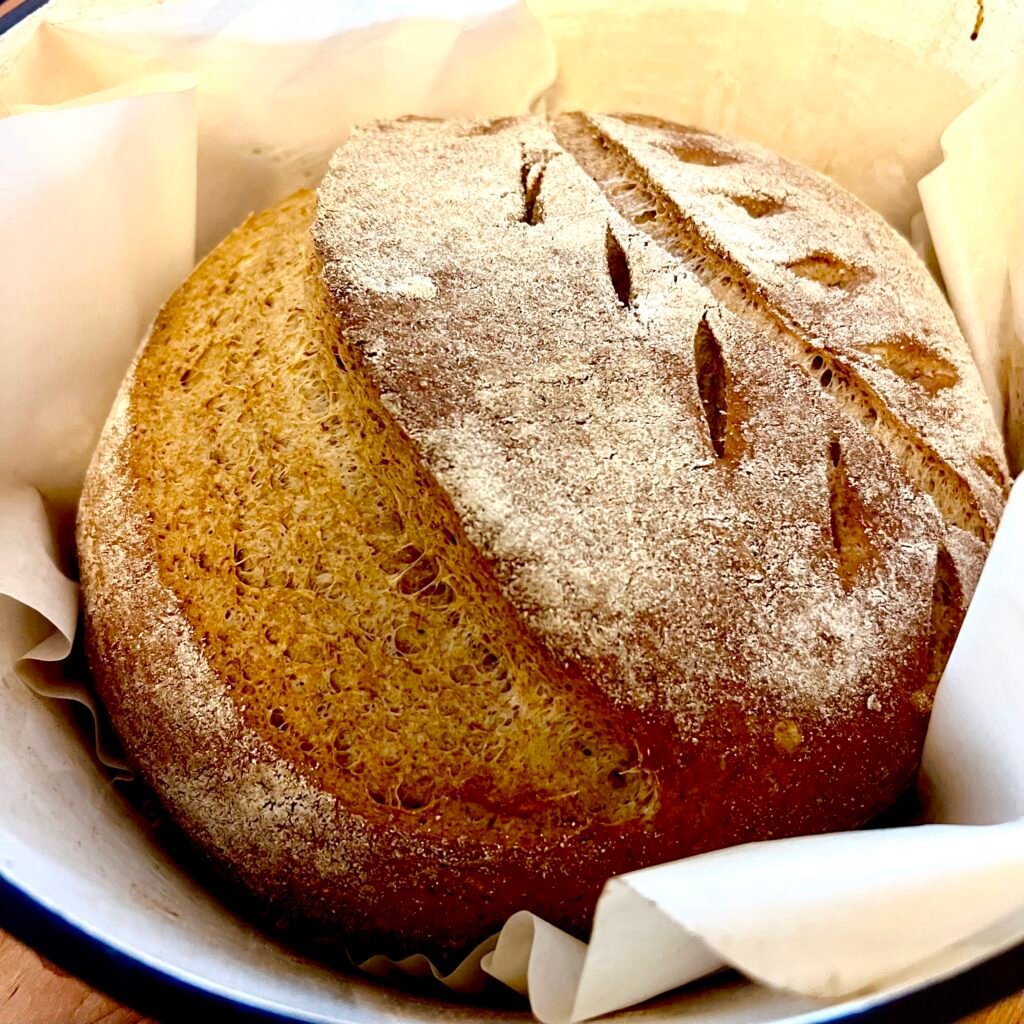
The 5-Minute 1-2-7 Keto Sourdough Blueprint, by comparison, contains approximately ~2g net carbs per slice, depending on the exact recipe and serving size.
Net carbs are commonly calculated by subtracting fibre — and, depending on the calculation, certain sugar alcohols — from total carbohydrate. For someone following a Flexible Keto approach, this can be a useful calculation.
But net carbs do not guarantee a particular blood-glucose response. The carbohydrate calculation tells you what’s in the bread. Your body tells you how you respond to it.
5. Can Sourdough Help Prevent Blood Sugar Spikes?
It may help reduce the size of the glucose response in some circumstances, but it cannot guarantee that a spike won’t occur.
An active clinical trial is currently studying this exact question in adults with prediabetes — using traditional wheat sourdough, specifically testing whether longer fermentation times, which increase lactic and acetic acid content, produce a measurably smaller glucose response than shorter fermentation.[4] That research is still underway, which tells you something important: even the scientific community is still working out precisely how much fermentation duration matters — and that trial isn’t testing the Sinless Sourdough keto formulation at all.
In my own case, the 5-Minute 1-2-7 Keto Sourdough Blueprint — the Sinless keto version — produced essentially no measurable spike on my CGM. Your result may be different, which is exactly why testing your own response matters.
6. Does Fermentation Reduce the Carbs in Sourdough?
Fermentation can change how the bread’s carbohydrates behave in your body, but it does not eliminate them.
During fermentation, microorganisms metabolize some dough components and produce organic acids and other compounds, which can alter the structure and digestibility of starch. But if you start with a high-carbohydrate wheat flour, you don’t end up with a carbohydrate-free loaf simply because it fermented — that’s an important misconception.
Fermentation is part of what makes sourdough special. It isn’t a magic eraser for carbohydrate. That’s why Flexible Keto sourdough combines fermentation with a fundamentally different, lower-carbohydrate flour formulation from the start.
7. What Is the Difference Between Traditional Sourdough and Keto Sourdough?
The biggest difference is the flour base and resulting carbohydrate load. Traditional sourdough is generally made primarily from wheat or other grain flours, and even after fermentation the finished bread can contain substantial carbohydrate.
Flexible Keto sourdough starts with a different nutritional goal from day one: instead of trying to make wheat flour somehow behave like keto bread, the formulation uses alternative ingredients and high-fibre components to dramatically reduce digestible carbohydrate — while keeping the fermentation, flavour, texture, crust and real-bread experience intact.
That’s the idea behind Sinless Sourdough: don’t just ferment a high-carbohydrate flour and call it keto. Start with a lower-carbohydrate formulation.
8. Why Can Two Low-Carb Breads Affect My Blood Sugar Differently?
Two breads can both advertise “4g net carbs” and still produce very different glucose responses, because the number on the label doesn’t tell the whole story.
The type of fibre, starches, sweeteners, ingredients, processing, food structure and portion size can all influence how a food behaves in your body — and then there’s your individual metabolism on top of that. Your blood glucose response is affected by far more than the number printed on a package. Your body is the final test.
9. Can a Food Really Be Low-Carb but Still Spike My Blood Sugar?
Yes. A product can have a relatively low calculated carbohydrate content and still produce a noticeable glucose response in some people — this is particularly true with products containing various fibres, modified starches or sugar alcohols, since those ingredients don’t all behave identically from person to person.
That doesn’t mean every low-carb product is misleading. It means “low carb” and “no glucose response” are not the same claim. I’ve tested products that looked excellent on paper but didn’t produce the response I expected — and I’ve tested my own Sinless Sourdough and seen essentially no measurable glucose spike for me. Again: for me does not automatically mean for you.
10. How Can I Tell Whether a Keto or Diabetic-Friendly Bread Will Actually Affect My Blood Sugar?
Start with the label — but don’t stop there.
Look at the total carbohydrate. Don’t rely entirely on the large claims printed on the front of the package.
Look at the fibre. Fibre can substantially change the nutritional profile of a bread.
Read the ingredients. Look at what the bread is actually made from rather than relying on words such as “keto,” “low carb” or “diabetic-friendly.”
Look at the serving size. A bread that contains 4g of carbohydrate per serving doesn’t tell you much if you eat three servings.
And if you use a CGM, test it yourself. Try to test foods under reasonably similar circumstances and pay attention to your own response.
Because here’s the most important lesson I’ve learned: your blood sugar is yours. What happens to me may not happen to you, your spouse, or another person with diabetes. When I tell you the Blueprint produced essentially no measurable spike for me, I’m showing you what happened in my body — and encouraging you to discover what happens in yours.
The Bottom Line
You don’t have to blindly trust the word “keto.” You don’t have to assume that traditional sourdough is automatically low-glycaemic. And you don’t have to assume that someone else’s blood sugar response will be yours.
Look at the ingredients. Look at the carbohydrate content. Understand how the bread is made. And if you’re monitoring your glucose, use your own data to learn how your own body responds.
Because when it comes to blood sugar: there is no “one size fits all.” Your body is the final test.
Related Questions You Might Ask Next
• What’s the difference between net carbs and total carbs?
• Why does the carb-to-fibre ratio matter more than net carbs alone?
See It For Yourself
The 5-Minute 1-2-7 Keto Sourdough Blueprint is the recipe behind the CGM results in this FAQ. Get the starter, the guide, and the exact loaf to test on your own glucose monitor.
Sources
Studies [1] through [4] below are about traditional wheat sourdough. Sinless Sourdough’s own results are reported through personal CGM testing only, not clinical research.
[1] Rolim, P.M. et al. “Consumption of sourdough bread and changes in the glycemic control and satiety: A systematic review.” Nutrition, 2022. pubmed.ncbi.nlm.nih.gov/35943419
[2] De Angelis, M. et al., as summarized in “Bread making technology influences postprandial glucose response: a review of the clinical evidence.” British Journal of Nutrition, 2016. cambridge.org
[3] Scazzina, F. et al. “Sourdough bread: Starch digestibility and postprandial glycemic response.” Journal of Cereal Science, 2009. sciencedirect.com
[4] “Effects of Sourdough Fermentation Duration and Acid Development on Postprandial Blood Glucose in Prediabetic Adults.” Ongoing clinical trial, ClinicalTrials.gov. clinicaltrials.gov/study/NCT06925451
Disclaimer
The glucose observations described above include personal CGM results and are shared for educational purposes. Individual blood-glucose responses vary significantly. This information is not medical advice and should not be used to diagnose, treat or manage diabetes or to adjust medication. If you have diabetes or take glucose-lowering medication, work with your healthcare professional when making significant dietary or medication changes.





Responses