Keto Sourdough and Health Benefits: Top 10 Questions Answered


Sinless Sourdough™
Keto Sourdough and Health Benefits
The Top 10 Questions Answered
“Health benefits” is a phrase that gets thrown around loosely in the bread aisle. Here we’re going to be precise about what fermentation, protein, fibre, and ingredient choices can actually do — and just as importantly, what they can’t.
Nothing on this page is medical advice. Keto sourdough does not diagnose, treat, cure, or prevent any disease. Where we reference research, we’re describing what that research found — not promising it will happen for you. If you have a health condition, talk to your doctor before changing your diet.
Why Sinless Sourdough Created This Approach
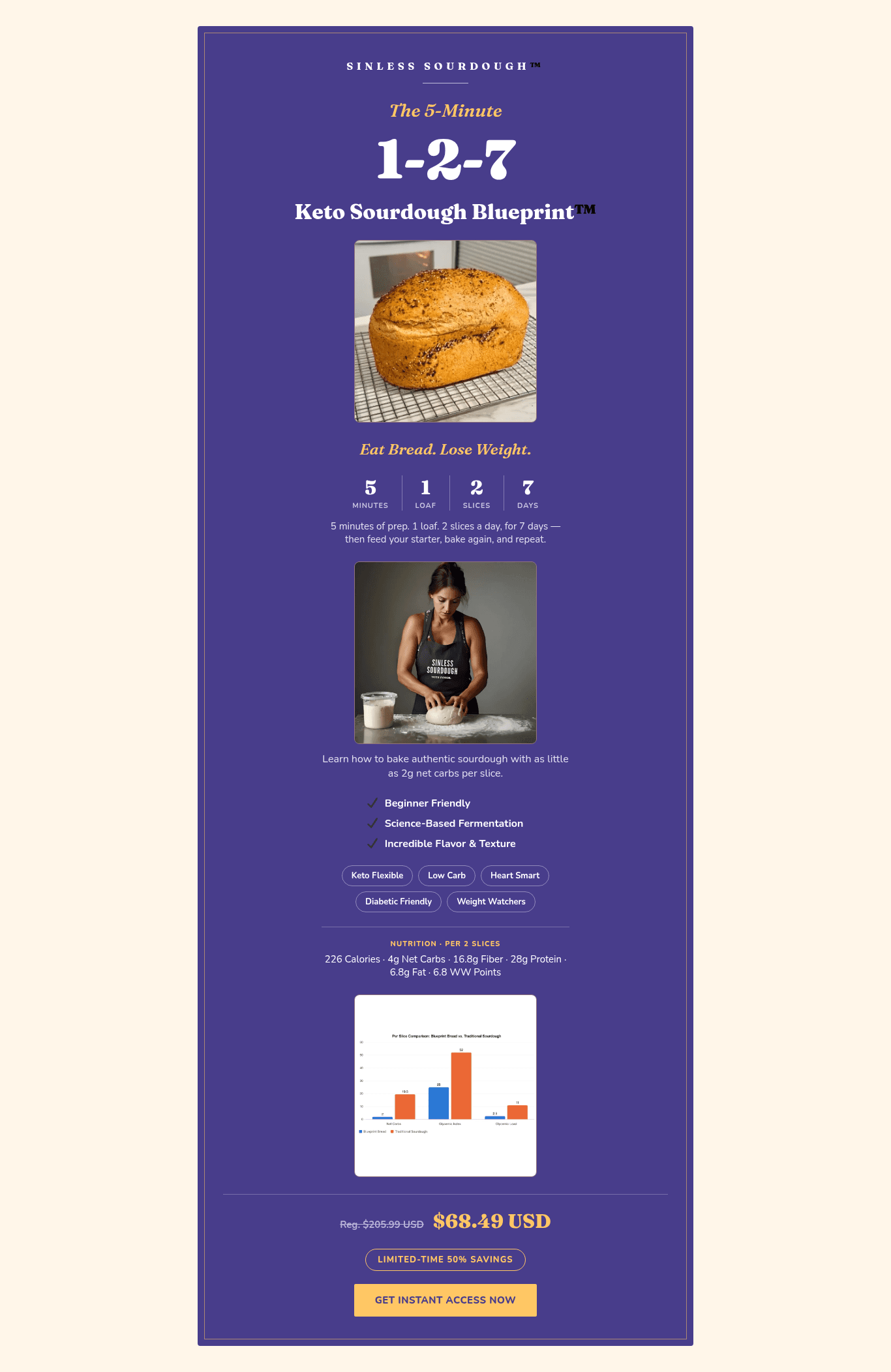
Sinless Sourdough™ focuses on keto sourdough for people who want real bread that also delivers more protein and fibre, and fewer additives, than most conventional loaves. Our 5-Minute 1-2-7 Keto Sourdough Blueprint™ combines genuine fermentation with that higher-protein, higher-fibre formula — which is exactly what makes the mechanisms discussed on this page (mineral absorption, gut fermentation, protein content) relevant to this specific bread, rather than a generic claim about sourdough in general.
Written by Shari MAC, CEO and founder of Sinless Sourdough. 30+ years in the food and wine industry, international award-winning cookbook author, former syndicated food and wine journalist. Shari developed the Flexible Keto approach to sourdough after losing over 70 lbs and shifting her own work from gourmet food and wine to low-carb baking.
https://sinlesssourdough.com/shop/
1. What Are the Actual Health Benefits of Keto Sourdough?
Keto sourdough combines real fermentation — wild yeasts and lactic-acid bacteria working on the flour over time — with a lower-carbohydrate, higher-protein, higher-fibre flour formulation than traditional wheat bread.
To be direct: this is not a treatment or cure for anything. It’s a different set of ingredients and a fermentation process that may offer advantages over conventional bread for some people — fewer net carbs, more protein and fibre, no artificial preservatives — as one part of an overall eating pattern, not a standalone fix.
2. Does Fermentation Make Nutrients Easier to Absorb?
Whole grains and seeds contain phytic acid, which can bind to minerals like magnesium, zinc, and iron before your body has a chance to absorb them — so you can eat a nutrient-dense food and still come up short.
Long fermentation breaks down a substantial portion of the phytic acid found in unfermented flour, which may improve how much of those minerals your body actually absorbs. This is a general mechanism of fermentation, not a claim specific to any diagnosed deficiency.
3. Is Keto Sourdough Good for Gut Health?
Real sourdough starts with wild yeasts and lactic-acid bacteria that work together over time, producing organic acids as they ferment the dough. Researchers have studied sourdough fermentation in the context of digestibility, including low-FODMAP baking approaches for people sensitive to certain fermentable carbohydrates.[1]
Individual digestive response varies significantly, and this is not a treatment for IBS, celiac disease, or any other digestive condition. If you have a diagnosed digestive condition, this is a conversation for your doctor or dietitian, not a label claim.
4. What’s the Concern With Preservatives Like Calcium Propionate?
Calcium propionate is a common mold inhibitor used in packaged bread to extend shelf life. It carries zero carbs, so it never shows up in a net-carb count — but some research has linked it to counter-regulatory hormones that may raise blood sugar independent of any carbohydrate content at all.[2]
Because keto sourdough is fermented and typically baked fresh rather than shelf-stabilized, there’s no calcium propionate in the recipe to begin with. Standard baker’s yeast bread can be preservative-free too — this isn’t unique to sourdough, but it is one thing worth checking on any ingredient label.
5. Does the High Protein Content Actually Matter for My Health?
Protein supports satiety and is a structural building block your body uses continuously — for muscle maintenance, enzymes, and much more. It’s simply not something most bread provides much of.
Two slices of the 5-Minute 1-2-7 Keto Sourdough Blueprint™ provide about 28g of protein — compared with roughly 4 to 6g in two slices of most conventional bread. That’s a meaningfully different contribution to your daily protein intake from the same food category.
6. Can Keto Sourdough Support Heart Health?
We want to be very clear here: keto sourdough is not a treatment for heart disease, and it does not diagnose, treat, cure, or prevent any cardiovascular condition.
Our founder, Shari MAC, lost her father, younger brother, and mother to heart disease within an 18-month period — that history is part of why this bread exists, but it’s a personal motivation, not a medical claim about what this bread can do for your heart.
What we can say factually: keto sourdough is lower in refined carbohydrate and free of certain preservatives compared to many conventional breads, which may be relevant to an overall heart-conscious eating pattern. Anyone managing cardiovascular risk, blood pressure, or cholesterol should work directly with their physician — not a bread label.
7. Is Real Sourdough Easier to Digest Than Regular Bread?
Some research suggests fermentation changes the structure of starch and may reduce certain fermentable carbohydrates that trigger digestive discomfort in sensitive individuals — this is part of what’s behind low-FODMAP sourdough research specifically.[1]
This varies considerably by person, by recipe, and by fermentation length. It is not a guarantee of improved digestion for everyone, and it’s not a substitute for medical evaluation if you’re experiencing ongoing digestive symptoms.
8. Does This Bread Support Stable Energy Levels?
A smaller net-carb load, paired with more protein and fat than carbohydrate, tends to produce a gentler blood sugar rise and fall than a higher-carb food — and some people associate that gentler curve with steadier energy through the day.
Individual response to any food varies with your health status, activity level, sleep, and more. This describes a general mechanism, not a promise of how you personally will feel.
9. What Does “Third-Party Tested” Actually Mean for This Starter?
The Biome Boss™ starter has been DNA-sequenced and independently, third-party tested — confirming the presence of genuine wild yeasts and lactic-acid bacteria, and separately verifying food safety and microbiological stability.
This is an authenticity and safety verification — proof that the starter contains what it claims to and is safe to consume — not a health outcome claim. It answers “is this real sourdough?”, not “will this improve my health?”
10. Is Keto Sourdough Actually Nutritionally Better Than Regular Bread?
Compared to many conventional breads, keto sourdough typically has significantly fewer net carbs, more protein, more fibre, and no artificial preservatives. Those are measurable, comparable facts.
Per 2 daily slices, the Blueprint provides about 4g net carbs, 28g protein, 16.8g fibre, 6.8g fat, and 226 calories (6.8 WW points).
Whether that makes it “better” depends entirely on your individual goals and health status — this is nutritional comparison, not a universal health verdict, and it is not a substitute for medical or dietary advice from a qualified professional.
Related Questions You Might Ask Next
• What does DNA-sequenced or third-party tested actually mean?
• What actually causes a blood sugar spike from bread?
Ready to Try Real Sourdough?
The 5-Minute 1-2-7 Keto Sourdough Blueprint™ ships with your Biome Boss™ starter, the full video course, and a surprise bonus — free shipping to Canada and the USA.
Sources
These studies describe general sourdough fermentation research. They are background information, not proof that any specific product will produce these effects for you.
[1] “Use of Sourdough in Low FODMAP Baking.” PubMed. pubmed.ncbi.nlm.nih.gov/29932101
[2] Findings on calcium propionate and counter-regulatory hormone response, as discussed in coverage of a Harvard-affiliated randomized crossover trial. See also: “Does Sourdough Bread Provide Clinically Relevant Health Benefits?” PMC. pmc.ncbi.nlm.nih.gov/PMC10399781
“The Sourdough Microbiome.” American Society for Microbiology. asm.org
“Sourdough Microbiome Comparison and Benefits.” PMC. pmc.ncbi.nlm.nih.gov/PMC8306212
“Nutritional Benefits of Sourdough: A Systematic Review.” PubMed. pubmed.ncbi.nlm.nih.gov/36811591
Disclaimer
This page is for education only. It is not medical advice and does not diagnose, treat, cure, or prevent any disease. If you have diabetes, insulin resistance, heart disease, digestive conditions, or another health condition, speak with your doctor before changing your diet. Statements on this page have not been evaluated by the Food and Drug Administration.
The science referenced above (fermentation, mineral absorption, gut bacteria, blood sugar mechanisms) reflects general, established nutrition research explaining how these mechanisms generally work in the body. It is not a guarantee of how this specific product will affect your health. Individual results vary based on your body, diet, activity level, and health conditions.





Responses