Keto Sourdough and Weight Loss: Top 10 Questions Answered

Sinless Sourdough™
Keto Sourdough and Weight Loss
The Top 10 Questions Answered
Bread is not the same for everyone. The type, the amount, the ingredients, and the baking process all matter — and if you’ve been curious whether the right bread could actually support your weight goals, or whether that’s just marketing, these are the ten questions we hear most often.
A possibility — not a promise. This page shows how the right bread may help some people stay on track with their weight goals. It is not a guarantee, and it works alongside your overall food choices, activity, sleep, and health — not instead of them.
North Americans eat an average of 45 to 50 lbs of bread per year, most of it with a glycaemic index around 75 — enough to cause rapid blood sugar spikes. That’s the backdrop for every question below.
Why Sinless Sourdough Created This Approach
Sinless Sourdough™ focuses on keto sourdough for people who don’t want to give up bread while working toward their weight goals. Our 5-Minute 1-2-7 Keto Sourdough Blueprint™ was built around a lower-net-carb, higher-protein, higher-fibre formula specifically because that combination is what the carb-to-fibre math and glucose mechanics on this page are actually pointing to — not a coincidence, but the design goal.
Written by Shari MAC, CEO and founder of Sinless Sourdough. 30+ years in the food and wine industry, international award-winning cookbook author, former syndicated food and wine journalist. Shari developed the Flexible Keto approach to sourdough after losing over 70 lbs and shifting her own work from gourmet food and wine to low-carb baking.
https://sinlesssourdough.com/shop/
1. Can Eating Bread Actually Help You Lose Weight?
Bread itself doesn’t cause weight loss — but the type of bread you choose affects the blood sugar and insulin response that plays a role in fat storage and fat burning. Fewer net carbs means a smaller blood sugar spike and a smaller insulin response, and large insulin responses can reduce how much fat your body burns while promoting storage.
Two slices of the 5-Minute 1-2-7 Keto Sourdough Blueprint™ contain about 4g net carbs (20.8g total carbs minus 16.8g fibre), compared with roughly 30g net carbs in two slices of some traditional breads. That’s the math behind the smaller spike — not a promise of weight loss on its own.
2. Why Am I Hungry Again an Hour After Eating Bread?
Regular bread can cause a rapid blood sugar rise, which can trigger hunger and cravings. Many common breads are also low in protein and fibre, which may leave you looking for more food soon after eating — and extra hunger makes it almost impossible to stick to any diet plan.
Per 2 slices, the Blueprint’s protein (28g) plus fat (6.8g) adds up to roughly 34.8g — well above its 20.8g of total carbs. That ballast slows digestion, so sugar trickles into your bloodstream gradually instead of all at once, which can help keep you fuller for longer.
3. Why Does One Sandwich Add So Many Carbs?
Two slices of some regular breads have about 15g net carbs each — 30g of net carbs per sandwich. Your body has to process that sugar before it can start burning stored fat.
Two slices of the Blueprint run about 4g net carbs, compared with roughly 30g net carbs in two slices of some traditional breads — nearly 26g less sugar for your body to process in a single meal.
4. Why Is Losing Fat So Hard, Even When I’m “Eating Healthy”?
Some regular breads have almost no fibre for your gut bacteria to ferment, so you miss out on the fullness-supporting compounds they’d otherwise produce. Feeling fuller makes it easier to eat less without relying only on willpower.
Protein and fat (about 34.8g combined per 2 slices of Blueprint) outweigh total carbs (20.8g) by nearly 14g. That ballast slows the blood sugar rise, which works alongside the fullness signals your gut bacteria help produce, from the Blueprint’s 16.8g of fibre per 2 slices.
5. Why Do I Crash Every Afternoon?
A high-sugar or high-carb meal can send your blood sugar up quickly. When it falls, you may feel tired, foggy, hungry, and ready for more food — cortisol signals your body that it needs quick energy, which shows up as cravings, while the fatigue makes you too tired for activity.
A smaller net-carb load (4g) paired with more protein and fat than carbs (34.8g vs. 20.8g) means less of a rapid rise — and less of a rapid fall. Fewer sharp swings may mean a steadier afternoon.
6. Why Have All My Diets Failed? Is It My Fault?
Severe food restriction increases hunger, cravings, and overeating. A bread that fits your plan means you feel less deprived — which is a structural problem, not a willpower one.
A bread that keeps net carbs at 4g per 2 slices, with protein and fat outweighing carbs, is less likely to trigger the sharp blood sugar swings that drive the cravings and rebound hunger behind so many abandoned diets.
7. Does Real Sourdough Help More Than Regular Bread?
Yes — genuine long fermentation can lower glycaemic load by up to 30% compared to regular bread. That’s a real benefit. But even at 30% lower, traditional sourdough is still too high in carbohydrate for a truly low-carb, keto-friendly lifestyle.
Real, long-fermented artisan sourdough is usually baked at home or by specialty bakers, and typically isn’t available in standard supermarkets. The Blueprint combines that same genuine fermentation with a fundamentally lower-carbohydrate flour formulation from the start — not just wheat flour fermented longer.
8. What’s Really in “Healthy” Whole Grain Bread That Works Against You?
Whole grain bread is made with flour that still contains the bran — and that bran carries phytic acid, which can block the absorption of minerals like iron, zinc, magnesium, and calcium, leaving you “fed” but under-nourished. That can drive cravings, low energy, and a metabolism that resists fat loss.
Magnesium specifically supports normal blood-sugar control, which is part of what keeps fat burning working in your favour. The Blueprint’s long fermentation process breaks down a substantial portion of the phytic acid found in unfermented flour, so your body actually absorbs more of the minerals you’re eating.
9. Do Keto Breads Actually Help With Weight Loss, or Do They Spike Blood Sugar Too?
Most keto or low-carb breads rely on refined starches and fibre isolates that can still digest quickly, producing blood sugar and insulin responses that drive hunger, cravings, and fat storage — even when the label says “low carb.”
Real sourdough fermentation produces organic acids — like lactic acid and propionic acid — that may slow starch digestion and lower the after-meal blood sugar rise. The oven kills the live cultures, but those acids stay in the finished loaf. Refined-starch keto breads skip that fermentation step entirely, so the net-carb number can be low with nothing there to slow digestion down.
10. How Many Carbs Are in the Blueprint Compared to Other Breads?
Here’s the net carb comparison, per slice, sourced from Carb Manager for the comparison breads:
*Real, long-fermented sourdough is usually baked at home or by artisan bakers and typically isn’t available in standard supermarkets. Values based on 2 medium slices as listed.
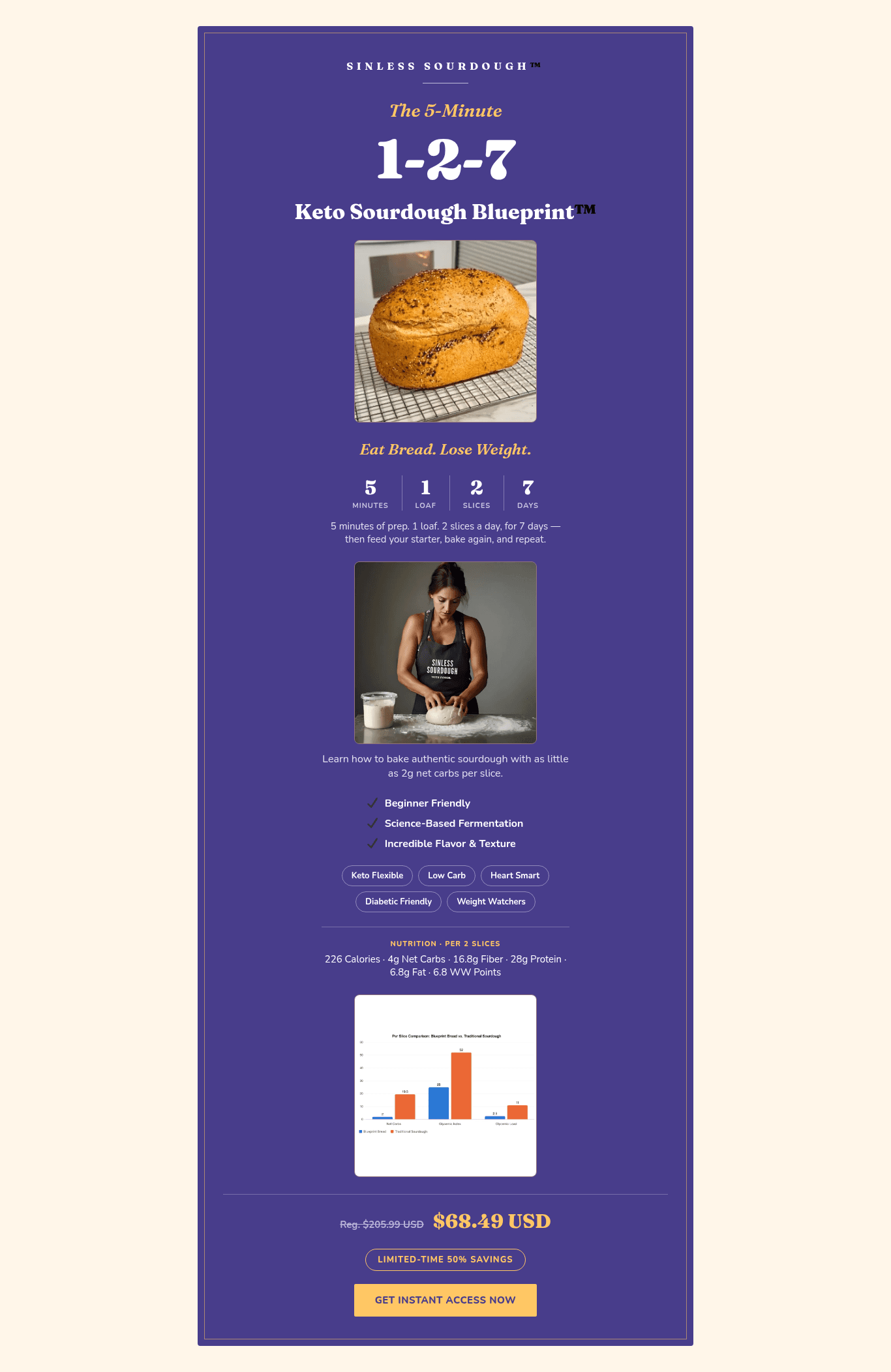
Per 2 daily slices, the Blueprint provides about 4g net carbs, 28g protein, 16.8g fibre, 6.8g fat, and 226 calories (6.8 WW points). Nutritional profiles vary by recipe across the Sinless Sourdough™ system — this is one example.
Related Questions You Might Ask Next
• What’s the difference between net carbs and total carbs?
• Why does the carb-to-fibre ratio matter more than net carbs alone?
Ready to Try Real Sourdough?
The 5-Minute 1-2-7 Keto Sourdough Blueprint™ ships with your Biome Boss™ starter, the full video course, and a surprise bonus — free shipping to Canada and the USA.
Disclaimer
The 5-Minute 1-2-7 Bread has significantly fewer carbs and provides protein and fibre compared with the common breads shown here. These features may help some people stay on track with their weight goals, but the bread system alone does not guarantee weight loss. Results are different for everyone, and depend on your food choices, activity, sleep, medications, health, and other factors.
This page is for education only. It is not medical advice and does not diagnose, treat, cure, or prevent any disease. If you have diabetes, insulin resistance, heart disease, or another health condition, speak with your doctor before changing your diet. Statements on this page have not been evaluated by the Food and Drug Administration.






Responses