
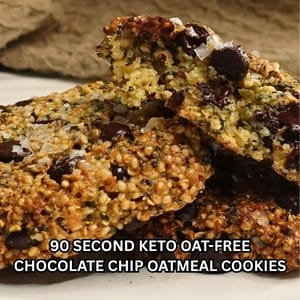
90 SECOND KETO OAT-FREE CHOCOLATE CHIP OATMEAL COOKIES

The Keto Baking Mechanic™ — Recipes
90 Second Keto Oat-Free Oatmeal Chocolate Chip Cookies
Where We Create, Tweak and Enhance
Keto and Low Carb Breads and Baked Goods
🍪 No Oats, No Grains, No Blood Sugar Spike — Under 2 Minutes
What if you could have a warm, chewy oatmeal-style cookie on your plate in under two minutes — no oats, no grains, no blood sugar spike? That’s exactly what 90 Second Keto Oat-Free Oatmeal Chocolate Chip Cookies deliver. Built with hemp hearts for texture and beef gelatin for structure and protein, these cookies satisfy that classic oatmeal-cookie craving in a way that fits your flexible keto, grain-free lifestyle. Whether you reach for the microwave or crank up the toaster oven, the result is a real cookie — chewy, rich, and packed with nutrients.
What makes this recipe different? There’s no discard, no starter, no resting time, and no complicated technique. Just one bowl, a handful of honest ingredients, and two minutes of your time. These are 90 Second Keto cookies built for the real world.
🎥 Follow The Keto Baking Mechanic on YouTube for more flexible keto recipes: @theketobakingmechanic
https://sinlesssourdough.com/shop/
The Difference
What Makes This Recipe Different
Most keto cookie recipes still rely on almond flour, coconut flour, or a blend of both. They produce flat, dense, or crumbly results that don’t come close to mimicking an oatmeal cookie. This 90 Second Keto recipe takes a completely different approach.
Hemp hearts replace oats. They carry a similar mild, nutty chew and visual texture to rolled oats, without the carbohydrates. Beef gelatin replaces gluten and starch structure. It creates the chewy bite that oatmeal cookies are known for while contributing collagen protein. The result is a cookie that looks and behaves like a traditional oatmeal cookie — without a single grain in sight.
The 90-second microwave method is also unique. Most baked goods require an oven and a minimum of 10–15 minutes. This recipe gives you a fully cooked, rested cookie in under two minutes. That’s genuine convenience for a genuinely good cookie.
The Science
Why It Works — The Structural Science
Understanding why this recipe works helps you bake it successfully every time.
Beef gelatin is the structural engine. When combined with egg and moisture, gelatin forms a protein network that replaces the role of gluten and starch found in traditional cookies. It binds all the ingredients into shapeable dough, thickens the mixture, and creates the signature chew you expect from an oatmeal cookie.
Hemp hearts contribute fat, protein, and a gentle, grain-like texture. They absorb moisture during cooking and provide visual bulk that reads as oat-like without behaving like a grain.
Xanthan gum is optional but effective. It acts as a binder that tightens the dough before cooking, reduces spreading, and produces a softer, lighter bite. Without it, the cookie is denser and firmer — still excellent, just structurally different.
Double-acting baking powder provides a small lift during cooking, which helps the cookie stay tender rather than compressed.
The egg binds, adds richness, and reacts with the gelatin to create structure during the cooking process.
What to Expect
Taste & Texture
These cookies taste like a stripped-down, honest version of a classic oatmeal chocolate chip cookie. The hemp hearts are neutral and slightly nutty — they don’t dominate the flavour, they support it. The sugar-free chocolate chips bring richness. The flaky sea salt on top adds contrast and makes the chocolate pop.
Texture depends on your cooking method:
- Microwave method: soft, uniform, cake-like chew. No browning, tender throughout.
- Air fryer / convection / toaster oven: crisp or lightly golden edges, chewy interior. More bakery-style structure.
- With xanthan gum: softer, lighter, slightly puffed.
- Without xanthan gum: denser, firmer, more structured bite.
Both versions are satisfying. The microwave version is ideal for a quick daily treat. The oven version is ideal when texture and presentation matter more.
What You’ll Need
Ingredient Breakdown
- 1 large egg: Binds and adds moisture. The liquid activates the gelatin.
- ½ cup hemp hearts: The oat substitute. Provides grain-like texture, fat, and protein.
- 1 tsp double-acting baking powder: Lift and tenderness during cooking.
- 2 tbsp brown sugar sweetener (such as Swerve): Sweetness without sugar. Brown sugar varieties add a mild molasses-like depth that suits oatmeal cookies.
- 1 tbsp bovine beef gelatin: Structure, chew, protein density. The foundational ingredient.
- ¼ cup sugar-free chocolate chips: Richness, flavour, and the classic oatmeal cookie finishing note.
- ½ tsp xanthan gum (optional): Binder for immediate dough structure. Use if eating cookies right away. Skip if chilling the dough for 15 minutes.
- Flaky sea salt: Finishing element. Enhances sweetness and chocolate flavour.
Why It Matters
Why Beef Gelatin Matters
Beef gelatin is the ingredient most people haven’t used before — and the one that makes this recipe possible.
Bovine beef gelatin is concentrated collagen protein derived from connective tissue. In baking, it functions as a protein network that replaces the structure that gluten and starch would normally provide. In this recipe, it:
- Creates the chewy oatmeal-cookie texture without oats
- Binds the egg and hemp hearts into shapeable dough
- Thickens the mixture so it holds its shape during cooking
- Increases total protein content naturally
- Improves cookie stability during and after cooking
Nutritional Contributions of Beef Gelatin
- Carb-free and fat-free
- High in collagen protein
- May support connective tissue, joint, and skin health
- May support gut lining integrity
- May increase post-meal satiety
It is fully keto-compatible and integrates seamlessly with all other ingredients in this recipe.
Substitutions
Gelatin Substitution — Using Regular Knox Gelatin
If beef gelatin isn’t available, regular gelatin such as Knox can be used with adjustments.
Replace: 1 tbsp beef gelatin → With: 2 tsp regular gelatin (Knox or equivalent)
What Changes
- Dough becomes wetter and looser — more batter-like than dough
- Weaker structure before cooking
- Cookies will spread more
- Final texture is softer and flatter
How to Make It Work
- Refrigerate dough for 30–40 minutes before shaping
- Roll into balls after chilling
- Cook as directed (microwave or oven method)
- Cool fully before handling — structure firms on cooling
To improve structure with Knox gelatin, add ½ tsp xanthan gum to the dough. This thickens the batter, improves binding, and helps the cookies hold their shape during cooking.
Choose Your Path
Xanthan Gum, Psyllium Husks & Dough Structure
Dough structure is what separates a cookie that holds its shape from one that spreads flat or crumbles on the rack. In this recipe, you have three approaches depending on what ingredients you have available and how quickly you want to eat.
Option 1 — Use Xanthan Gum (Recommended for Immediate Eating)
If you want to eat the cookies as soon as they cool, add ½ tsp of xanthan gum to the dough before shaping. Xanthan gum gives the dough immediate structure — it acts as a binder that holds everything together during microwaving and baking. The cookies will retain their shape, resist spreading, and have a softer, lighter bite. This is the fastest route from bowl to cookie rack. No waiting, no refrigeration, no adjusting.
Option 2 — Skip Xanthan Gum (Refrigerate Instead)
If you prefer not to use xanthan gum, the dough can be chilled instead. Place the shaped dough balls into the refrigerator for at least 15 minutes before cooking. During this time, the hemp hearts absorb the egg moisture and the dough stiffens naturally. Keep in mind that cookies made without xanthan gum will not retain their shape as well as those made with it. They will spread more during cooking and have a denser, firmer structure. Still delicious — just a different result.
Option 3 — Add Psyllium Husks (Muffin-Style Texture)
You can also add 1 tsp of psyllium husks to the dough as an alternative binder. Psyllium husks are a soluble fibre that absorbs liquid and adds structure — but the texture shift is significant. Adding psyllium husks will change the cookie from dense and chewy to soft and muffin-like. If you enjoy a lighter, more tender bite with a slightly pillowy interior, this is worth trying. If you want the classic dense oatmeal-cookie chew, skip the psyllium husks and use xanthan gum instead.
Summary of Dough Structure Options
½ tsp xanthan gum → immediate structure, cookies hold shape, softer bite, eat right away
No xanthan gum + 15 min refrigeration → natural structure from hemp hearts absorbing egg, more spreading, denser result
1 tsp psyllium husks → extra fibre, softer texture, muffin-like interior instead of dense chew
Philosophy
About Measurements & Precision in Keto Baking
Traditional baking often teaches that cooking is art, but baking is science — meaning it must be precise. That’s why many bakers prefer weighing ingredients in grams instead of using cups. Keto baking does not always follow that traditional model.
You may use cups. You may use grams. What matters most is dough behaviour.
Gram measurements are approximate reference points based on commonly available brands. Ingredient density varies depending on:
- Brand
- Grind size
- How tightly ingredients are packed
- Humidity and storage conditions
For this recipe, the goal is a thick, shapeable dough. If it doesn’t come together, let it rest for 2 minutes — the gelatin and egg continue to thicken as they sit. If it’s too wet, add a small amount of additional hemp hearts.
What You’ll Need
Equipment
- Mixing bowl
- Spoon or spatula
- Parchment paper
- Microwave-safe plate or baking tray
- Wire cooling rack
Let’s Bake
Step-by-Step Instructions
Step 1 — Mix
Combine all ingredients in a mixing bowl: egg, hemp hearts, baking powder, brown sugar sweetener, beef gelatin, chocolate chips, and xanthan gum if using. Mix until a thick, cohesive cookie dough forms. The mixture will thicken as the gelatin begins to hydrate.
Step 2 — Shape
- Divide dough into 3 equal portions
- Roll each portion into a golf-ball-sized dough ball
- Place on a parchment-lined plate (microwave) or baking tray (oven method)
- Do not flatten the tops — they will spread naturally during cooking
- Sprinkle flaky sea salt over each dough ball
Microwave Method — 90 Seconds
- Microwave on high for 90 seconds
- Remove and rest on parchment for 5 minutes — do not move them yet
- Transfer to a wire rack and cool fully before eating
Result: soft, chewy, slightly cake-like cookie with a true oatmeal-cookie feel. No browning, uniform interior, tender throughout.
Convection / Toaster Oven / Air Fryer Method
- Preheat to 400°F (204°C)
- Bake for 15–20 minutes, until edges are set
- Cool on tray for 5 minutes
- Transfer to wire rack and cool fully before handling
Result: crisp or lightly golden exterior, chewy and soft interior. More traditional baked cookie structure with stronger flavour development.
Troubleshooting
Common Mistakes
- Moving cookies too early: the gelatin structure is fragile when hot. Always rest for the full 5 minutes before transferring.
- Skipping the parchment: cookies will stick without it.
- Flattening the dough balls: resist the urge. Let them spread naturally for the best texture.
- Undercooking in the microwave: if your microwave runs lower wattage, add 10–15 additional seconds.
- Not cooling fully: these cookies firm significantly as they cool. Eating them hot may feel underdone — give them the full cooling time.
- Using too much xanthan gum: stick to ½ tsp. More will make the texture gummy rather than soft.
Make It Your Own
Variations
- Swap chocolate chips for chopped walnuts or pecans
- Add ¼ tsp cinnamon for a spiced oatmeal-cookie flavour
- Use coconut aminos or a small amount of vanilla extract for added depth
Texture Summary
Air fryer / convection / toaster oven → crisp edges + chewy centre Microwave → soft, uniform, cake-like texture No xanthan gum → dense, firm, structured With xanthan gum → softer, lighter, slightly puffed
Ingredient Recommendations
Recommended Brands
Recommended Sugar-Free Chocolate Chips
Canada: Yupik Organic Dark Chocolate Chips, 70% Cacao, No Sugar Added
USA: Lakanto Sugar Free Chocolate Baking Chips Sweetened with Monk Fruit
Recommended Brown Sugar Sweeteners
🍫 Swerve Brown Sugar — Erythritol + prebiotic fiber (oligosaccharides) with natural flavors. One of the most popular keto brown sugar replacements; measures 1:1 like regular brown sugar. amzn.to/4uw2Xtw
🍫 Truvia Brown Sugar Blend with a Hint of Molasses — Erythritol + stevia leaf extract with a touch of molasses flavor. Sweeter than regular brown sugar, so you typically use ½ cup Truvia to replace 1 cup brown sugar. amzn.to/4vCj3T4
🍫 Lakanto Monk Fruit Golden Sweetener — Erythritol + monk fruit extract. A favourite for many keto baking recipes because it has a rich caramel-like flavor. Measures 1:1 like regular brown sugar. amzn.to/3QteFHj
By the Numbers
Nutrition Information
Why Sugar-Free Chocolate Chips Show Zero Net Carbs
You’ll notice that Lily’s sugar-free chocolate chips show 0g net carbs despite listing 8g total carbs per tablespoon and 32g total carbs for the full ¼ cup used in this recipe. This is not a mistake.
Sugar-free chocolate chips are sweetened with sugar alcohols and fibre-based sweeteners such as erythritol, inulin, or stevia blends. The human body does not digest or absorb these compounds the way it processes regular sugar or starch. They pass through the digestive system largely intact, meaning they do not raise blood glucose and do not contribute to your net carbohydrate intake.
Net carbs are calculated by subtracting fibre and non-digestible sugar alcohols from total carbs. For Lily’s chips: 8g total carbs − 3g fibre − 5g sugar alcohols = 0g net carbs per tablespoon. This is why keto and flexible keto baking recipes focus on net carbs rather than total carbs as the meaningful nutritional measure.
Because of this, simply subtracting fiber from total carbs on a standard nutrition label won’t give you the correct net carb count for the final recipe; you must also subtract the sugar alcohols. Always check the label of your specific brand, as formulations vary.
Per Cookie
Calories: ~251 kcal • Fat: ~20.7g • Protein: ~13.4g • Total Carbs: ~15.6g • Fibre: ~5.4g • Net Carbs: ~1.5g
Full Batch (3 cookies)
Calories: ~753 kcal • Fat: ~62g • Protein: ~40.2g • Total Carbs: ~46.9g • Fibre: ~16.2g • Net Carbs: ~4.7g
Nutritional values are estimates based on the specific brands used in this recipe. Actual values will vary. It is important to calculate your own nutritional values using the exact brands you purchase — the same brand may list different values in different countries. Always log your ingredients individually in your preferred tracking app using the product you have in your hand.
Keeping It Fresh
Storage
- Room temperature: store in an airtight container for up to 3 days
- Refrigerator: up to 7 days — cookies firm up when cold; rest at room temperature for 10 minutes before eating
- Freezer: freeze in a single layer on parchment, then transfer to an airtight bag for up to 1 month
Do not microwave frozen cookies — allow to thaw at room temperature.
Setting Expectations
Practice Batch Philosophy
The first time you make any new recipe, treat it as a learning batch. Observe how the dough comes together, how it behaves during cooking, and how the texture changes during cooling. Your microwave wattage, the brand of hemp hearts, and the type of chocolate chips will all influence the final result. The second batch will be better than the first. The third will be dialled in completely. These 90 Second Keto cookies are simple enough that you’ll get there quickly.
90 SECOND KETO OAT-FREE CHOCOLATE CHIP OATMEAL COOKIES
Make soft, chewy 90 Second Keto oatmeal chocolate chip cookies with hemp hearts and beef gelatin — grain-free, sugar-free, and ready in 90 seconds flat.
- Prep Time: 1 Minute
- Cook Time: 90 Seconds
- Total Time: 3.5 Minutes
- Yield: 3
- Category: Dessert, Snack
- Method: Air Fryer, Convection Oven, Microwave, Toaster Oven
- Cuisine: American
- Diet: Diabetic, Gluten-Free, Keto, Low-Carb
Ingredients
- 1 large egg — Binds and adds moisture. The liquid activates the gelatin.
- 1/2 cup hemp hearts — The oat substitute. Provides grain-like texture, fat, and protein.
- 1 tsp double-acting baking powder — Lift and tenderness during cooking.
- 2 tbsp brown sugar sweetener (such as Swerve) — Sweetness without sugar. Brown sugar varieties add a mild molasses-like depth that suits oatmeal cookies.
- 1 tbsp bovine beef gelatin — Structure, chew, protein density. The foundational ingredient.
- 1/4 cup sugar-free chocolate chips — Richness, flavour, and the classic oatmeal cookie finishing note.
- 1/2 tsp xanthan gum (optional) — Binder for immediate dough structure. Use if eating cookies right away. Skip if chilling the dough for 15 minutes. See the Xanthan Gum & Dough Structure section for full details.
- Flaky sea salt — Finishing element. Enhances sweetness and chocolate flavour.
Instructions
Step 1 — Mix
Combine all ingredients in a mixing bowl: egg, hemp hearts, baking powder, brown sugar sweetener, beef gelatin, chocolate chips, and xanthan gum if using. Mix until a thick, cohesive cookie dough forms. The mixture will thicken as the gelatin begins to hydrate.
Step 2 — Shape
- Divide dough into 3 equal portions
- Roll each portion into a golf-ball-sized dough ball
- Place on a parchment-lined plate (microwave) or baking tray (oven method)
- Do not flatten the tops — they will spread naturally during cooking
- Sprinkle flaky sea salt over each dough ball
Cooking Options
Microwave Method — 90 Seconds
- Microwave on high for 90 seconds
- Remove and rest on parchment for 5 minutes — do not move them yet
- Transfer to a wire rack and cool fully before eating
Result: soft, chewy, slightly cake-like cookie with a true oatmeal-cookie feel. No browning, uniform interior, tender throughout.
Convection / Toaster Oven / Air Fryer Method
- Preheat to 400°F (204°C)
- Bake for 15–20 minutes, until edges are set
- Cool on tray for 5 minutes
- Transfer to wire rack and cool fully before handling
Result: crisp or lightly golden exterior, chewy and soft interior. More traditional baked cookie structure with stronger flavour development.
Notes
Why Sugar-Free Chocolate Chips Show Zero Net Carbs
You’ll notice that Lily’s sugar-free chocolate chips show 0g net carbs despite listing 8g total carbs per tablespoon and 32g total carbs for the full 1/4 cup used in this recipe. This is not a mistake.
Sugar-free chocolate chips are sweetened with sugar alcohols and fibre-based sweeteners such as erythritol, inulin, or stevia blends. The human body does not digest or absorb these compounds the way it processes regular sugar or starch. They pass through the digestive system largely intact, meaning they do not raise blood glucose and do not contribute to your net carbohydrate intake.
Net carbs are calculated by subtracting fibre and non-digestible sugar alcohols from total carbs. For Lily’s chips: 8g total carbs − 3g fibre − 5g sugar alcohols = 0g net carbs per tablespoon. This is why keto and low-carb baking recipes focus on net carbs rather than total carbs as the meaningful nutritional measure. Because of this, simply subtracting fiber from total carbs on a standard nutrition label won’t give you the correct net carb count for the final recipe; you must also subtract the sugar alcohols. Always check the label of your specific brand, as formulations vary.
Per Cookie
- Calories: ~251 kcal
- Fat: ~20.7g
- Protein: ~13.4g
- Total Carbs: ~15.6g
- Fibre: ~5.4g
- Net Carbs: ~1.5g
Full Batch (3 Cookies)
- Calories: ~753 kcal
- Fat: ~62g
- Protein: ~40.2g
- Total Carbs: ~46.9g
- Fibre: ~16.2g
- Net Carbs: ~4.7g
Nutritional values are estimates based on the specific brands used in this recipe. Actual values will vary.
It is important to calculate your own nutritional values using the exact brands you purchase. Nutritional data can differ significantly from brand to brand — and the same brand may list different values in different countries. Canadian, American, and international versions of the same product are often formulated or labelled differently. Always log your ingredients individually in your preferred tracking app using the product you have in your hand.




Responses