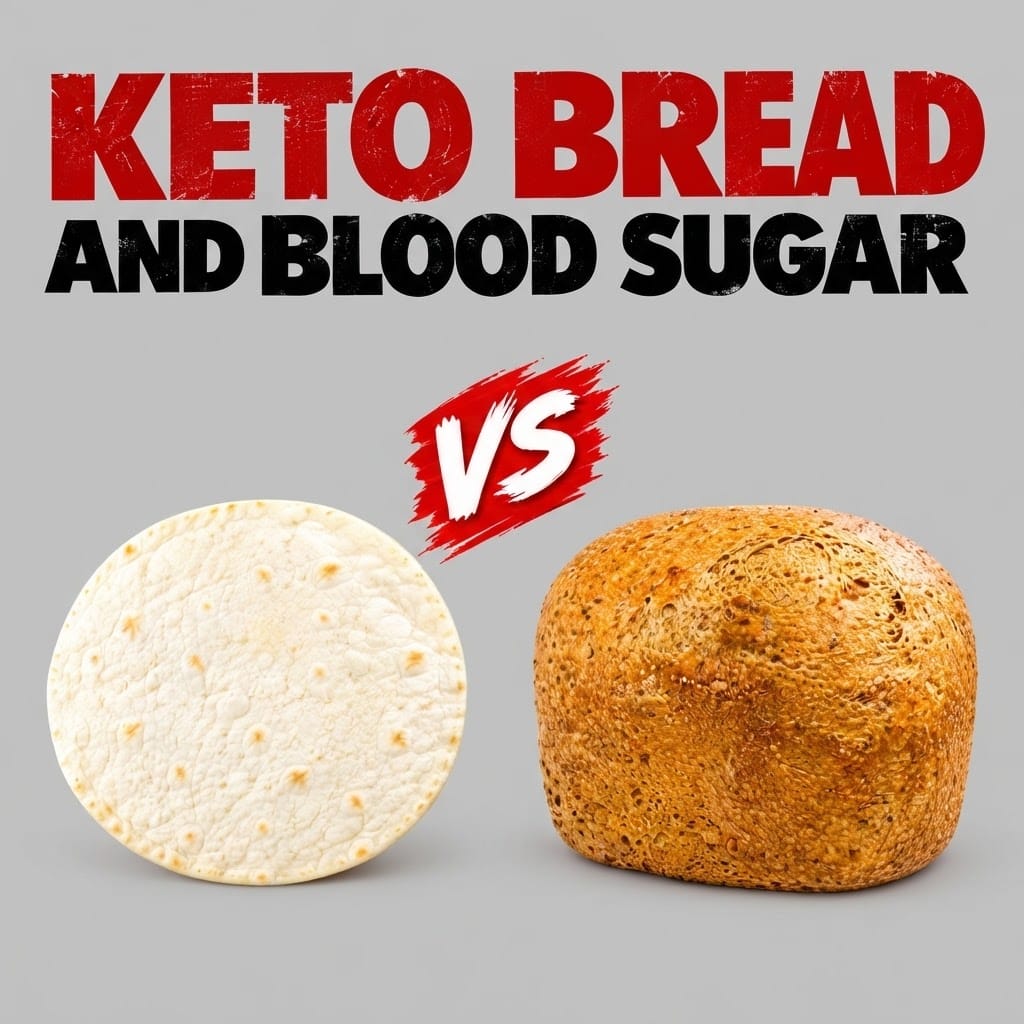
KETO BREAD AND BLOOD SUGAR

The Keto Baking Mechanic™ — Nutrition Science
Does Keto Bread Spike Your Blood Sugar? Store-Bought vs. Home-Baked
Where We Create, Tweak and Enhance
Keto and Low Carb Breads and Baked Goods
The Question
Does “Keto” on the Label Guarantee No Spike?
Plenty of bread products (tortillias, bagels, loafs) on the shelf say “Keto” and “2 net carbs” right on the front. But does that number actually mean your blood sugar stays flat after eating it? I ran two real tests on myself — store-bought keto tortillas against my own homemade REAL keto sourdough — to find out.
My homemade sourdough is the 5-Minute 1-2-7 Keto Sourdough Blueprint bread, based on the video training course I built. Both tests landed at the same 4 net carbs, so it was a fair number to compare against.
Test 1
The Store-Bought Keto Tortillas
I ate two keto wraps, each labelled at 2 net carbs — 4 net carbs total for both. I’m not naming the brand, because the brand itself isn’t the point. My blood glucose right before eating was 5.6 mmol/L (101 mg/dL).
Sixty minutes later, it had climbed to 7.5 mmol/L (135 mg/dL)— a rise of 1.9 mmol/L (34 mg/d). I genuinely don’t know exactly what caused that jump. It could have been the modified starch, the calcium propionate preservative, some combination of ingredients, or something else entirely. What I do know is that my glucose rose significantly, despite the package claiming only 4 grams of net carbs.
A 1.9 mmol/L rise might not look dramatic to everyone, and I’ve personally heard from others who describe noticeably bigger spikes on similar products — though I don’t have a specific source to point you to for that, so take it as anecdotal, not documented. Either way, the point isn’t the exact number. It’s that we shouldn’t take the marketing on the package at face value.
My glucose did come back down afterward, and everyone’s body responds differently.
Test 2
The 5-Minute 1-2-7 Keto Sourdough Blueprint
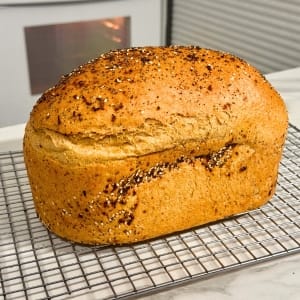
Same test, different bread: two slices of my own homemade Blueprint sourdough, also landing at 4 net carbs. My starting glucose was 5.2 mmol/L (94 mg/dL)— already lower than the tortilla test’s baseline, which matters for how you read what follows.
Blood sugar depends on a lot more than what you eat — DNA, sex, age, menopausal status, weight, and overall health all play a role. What follows reflects my body specifically. It’s not a prediction of what would happen to you, which is exactly why checking your own response matters more than following anyone else’s numbers.
Over roughly three hours, here’s what happened: 5.2 → 5.3 → 5.3 → 5.6 mmol/L. (94 → 95 → 95 → 101 mg/dL.) A total rise of just 0.4 mmol/L (7 mg/dL)— compared to the tortilla test’s 1.9 mmol/L (34 mg/d) rise in a single hour.
What matters here isn’t where I started. It’s how far it moved. Your baseline might be a 4, a 6, a 7, or an 8 mmol/L (72, 108, 126, or 144 mg/d) — we’re all different. The number worth watching is the size of the spike after eating, not the starting point.
An Important Caveat
These Weren’t Identical Conditions
I want to be upfront: these two tests weren’t run under identical conditions. The tortilla test started at a different time of day, at a different baseline, and I only checked it at the 60-minute mark. The bread test ran a full three hours with multiple checkpoints. This isn’t a perfectly controlled side-by-side — it’s two real tests, on my own body, on two different days. That said, the contrast is still worth sharing: one product moved me nearly two full millimoles in an hour, the other barely moved at all.
The Takeaways
What This Actually Shows
- The conditions weren’t identical, but the contrast between the two responses was still clear.
- The commercial tortillas caused a sharp, fast rise. The homemade Blueprint bread barely moved the needle.
- The tortilla spike stayed in a safe range for me personally, but less spike is always the better outcome — it asks less of your insulin response and helps avoid an energy crash later.
- When you bake at home, you control every ingredient, with no preservatives added — and that control extends to your glucose response too.
About the Bread
What Is the 5-Minute 1-2-7 Keto Sourdough Blueprint?
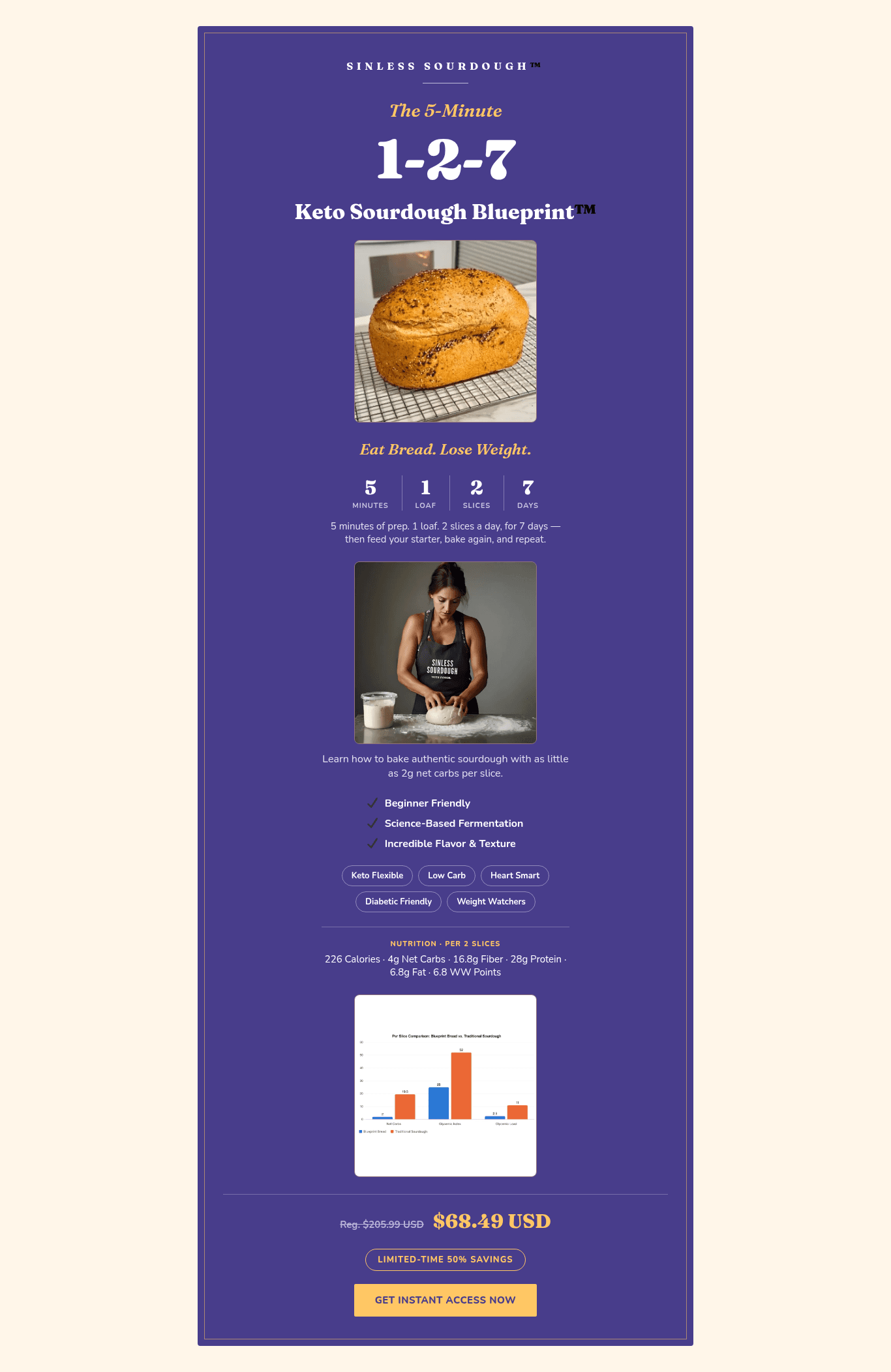
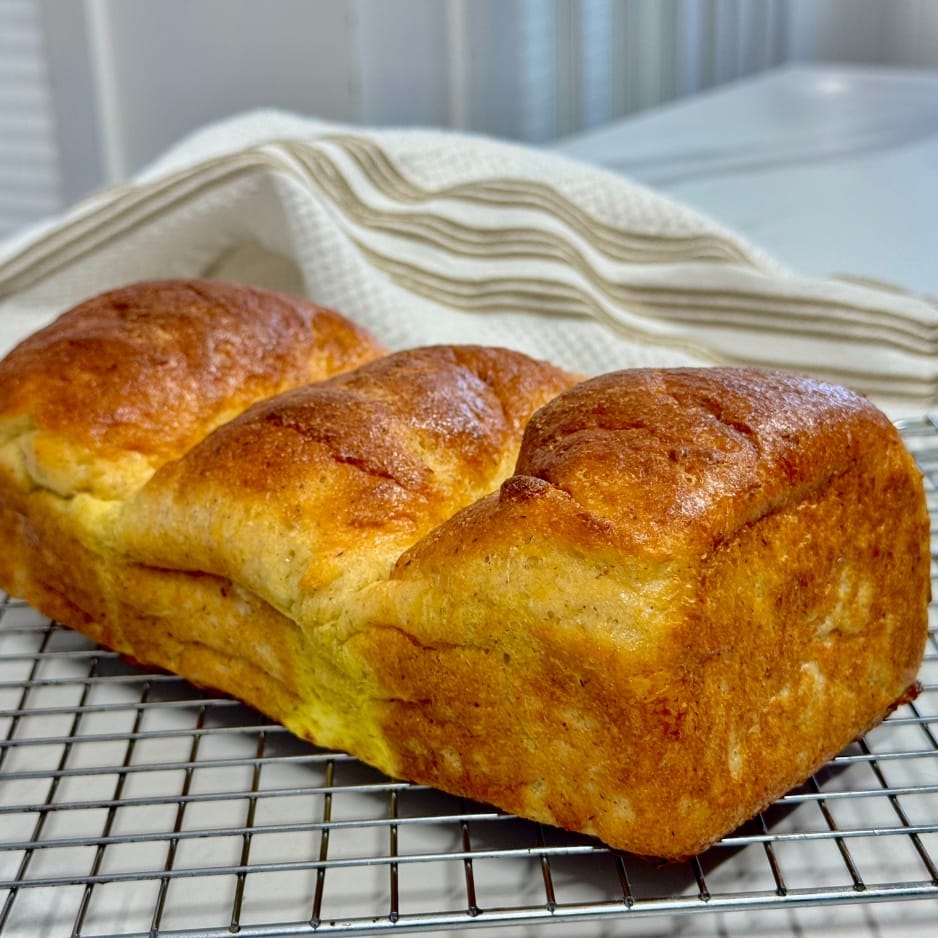
It’s an online video training course that walks you through reviving a dehydrated keto sourdough starter — shipped to you as part of the beginner training — and baking your first loaf from it. Once your starter is active, prep takes about 5 minutes, and you end up with one loaf: the “1-2-7” of it. One loaf, two slices a day, for seven days — by which point your starter has grown back to the top of the jar, ready for the next week’s loaf.
Per serving (2 slices): 4 net carbs • ~17g fibre • 28g protein
Two slices, every day, from the same starter, for as long as you keep feeding it. It’s genuinely one of my favourite things I’ve built, and I hope you get a chance to try it.
🎥 Follow The Keto Baking Mechanic on YouTube for more flexible keto recipes: @theketobakingmechanic
https://sinlesssourdough.com/shop/
Your health goals. Your rules. Your bread.
Disclaimer: The glucose numbers shared in this post reflect one individual’s personal response under informal, non-identical test conditions — they are not a clinical study and are not a prediction of how any other person’s body will respond. Blood sugar is influenced by many personal factors, including genetics, age, sex, hormonal status, weight, and overall health. This content is for educational and informational purposes only and does not constitute medical advice. If you are managing diabetes, prediabetes, or insulin resistance, please monitor your own blood sugar and consult a registered dietitian or healthcare provider before making dietary changes.

Responses